Bogotá · Next Generation Digital Action 2026
The Synaptic Network for Latent Stuff
An urban network that reconnects discarded stuff with the people, places, routes and processes that can give it a next destination. Reconnecting objects, people, places and value.
The challenge
What happens when we call somethingwaste?
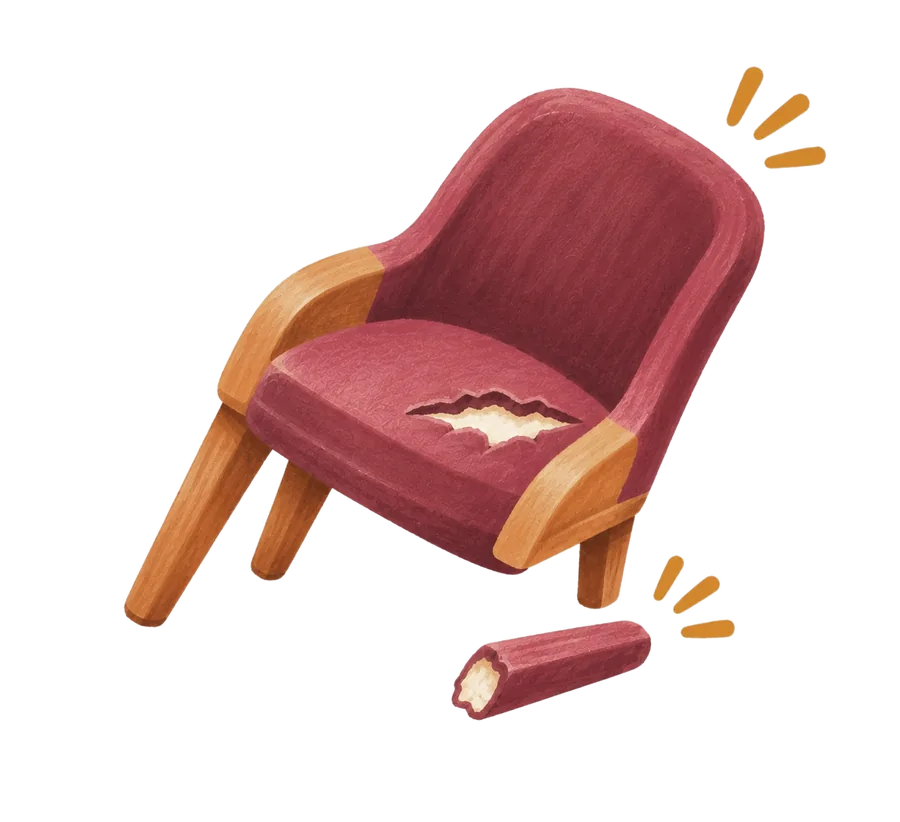
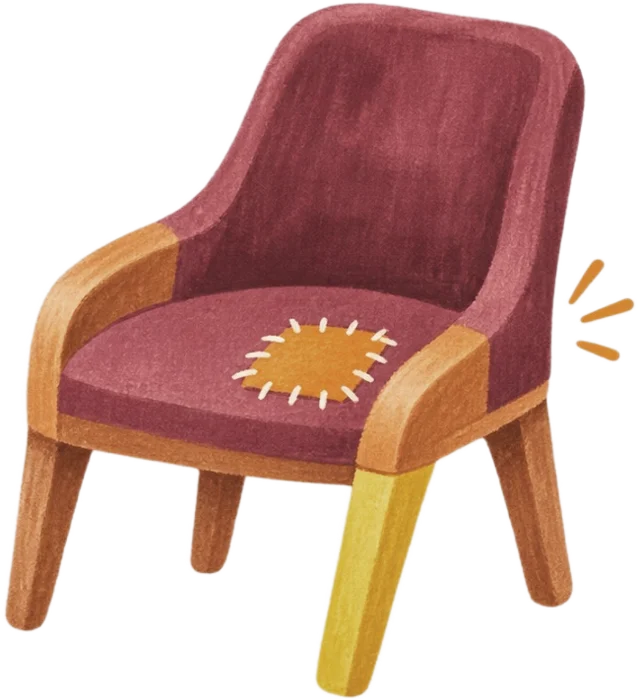
The word changes how we treat the thing. Once an object is labelled waste, nobody looks at who could still use it, whether it could be repaired, or what its materials are worth.
Often the object has not lost its value. It has lost its connections. ReNeu starts from a different question: what if it is not waste yet, but latent stuff?
The real problem
Bogotá does not have a waste problem.Bogotá has a connection problem.
Objects with value still end up on sidewalks, empty lots and public space. Residents who want to get rid of them, repairers, people who need them, informal recyclers and collection routes all exist in the same city. They simply do not meet.
Figures as reported in the ReNeu project blog for Bogotá.
About 1 in 6 tonnes of the city's daily waste is picked up from illegal dumping hotspots.
One dot for each of the 478 active illegal dumping hotspots at the end of 2025.
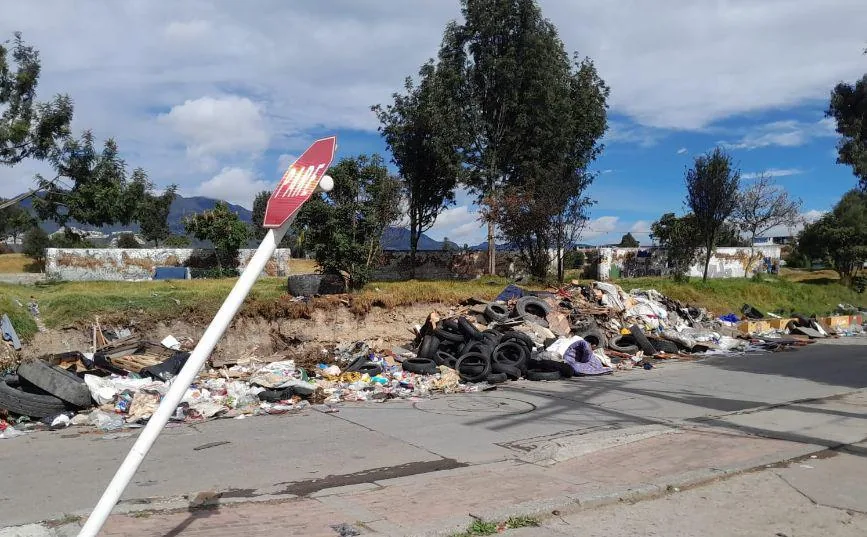
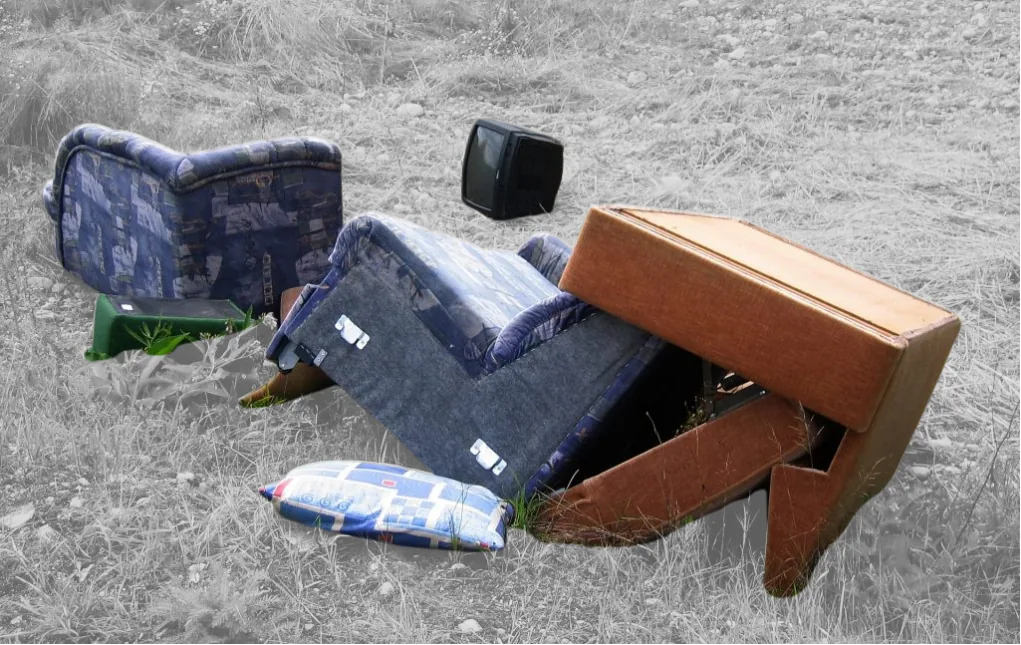
Discarded furniture in public space. Photo source cited in the pitch deck: UAESP Instagram.
Where the system breaks
A sofa moves from home, to street, to landfill.
Somewhere along the way it gets called waste. Its value did not disappear at that moment. Its connection to the system did. Four structural failures explain why.
Collection that misses people's routines
Mobile Ecopoints run on fixed schedules that do not match how a neighbourhood actually lives.
Informal disposal is easier
An informal truck takes one phone call and a small payment, with no further responsibility. The formal route means schedules, transport, drop-off points and finding reuse channels. Convenience, more than lack of awareness, drives illegal dumping.
Stuff becomes waste too early
A sofa that needs a minor repair, a reusable door, an appliance with working parts. All of them are treated as waste before the end of their useful life, because the system is built for removal, not evaluation.
A single path
Collect, transport, dispose. The model is linear, and no step in it asks whether the object could still be useful to someone.
Illustrations of the situations described by the team.
The concept
Latent stuff
Stuff that has been physically disconnected from its use but still holds potential value. Light it up and the label changes. The stuff is not the problem; the missing connections around it are.
ArmchairFunctional valueThe frame is still standingTelevisionMaterial valueGlass, metal and electronicsSofa sectionEconomic valueFittings and parts can be resoldCushionSocial valueSomeone nearby could use it todayWooden baseTransformative valueCould become a bench or a shelfPlastic trayMaterial valuePlastic back into supply chains
TyresTransformative valueA new life as planters or flooringTimberMaterial valueWood for repairs and new productsTextilesSocial valueClothing and fabric to pass onBoards and cratesEconomic valueSellable to material buyers
Discarded objects in public space. Photo source cited in the pitch deck: UAESP Instagram. Value notes are examples of what the network would look for.
A chair can become
Another chair, a component, a material or a new product. Value comes in five kinds:
How it works
Nature already solved it.
A single neuron can do very little. Connected neurons create pathways. ReNeu applies the same logic to the city: it links latent stuff with the people, places, mobility and processes that can activate its next destination.
Tap or click a neuron to make it fire.
Digital Node
Connection with information and possibilities. An AI-enabled app that understands the stuff first.
- Register
- AI assessment
- Alternatives
- Credits
Mobile Node
Connection with space, time and movement. AI spatial planning that brings routes to where people are.
- Demand points
- Adaptive routes
- Risk prediction
- Pickups
Physical Node
Connection with people, materials and action. A deployable workshop where potential becomes real.
- Repair
- Recovery
- Vendors
- Community
These are not three separate services. They are layers of one network, and information moves between them continuously.
Digital Node
First, understand the stuff.
A citizen registers an object in the ReNeu app. The system assesses its condition and points it toward the best available next destination.
The app works as an AI-enabled decision and coordination layer. It captures data about the object, evaluates its latent potential, connects the citizen with alternatives and feeds what it learns back into the network.
The app does not begin with disposal. It begins with possibility.
Destinations, in order of preference
- Repairbring it back to its original use
- Exchangepass it directly to someone who needs it
- Transformturn it into something new
- Recover materialsreturn wood, metal, plastic, glass or electronics to supply chains
- Responsible disposalonly once every alternative has been explored
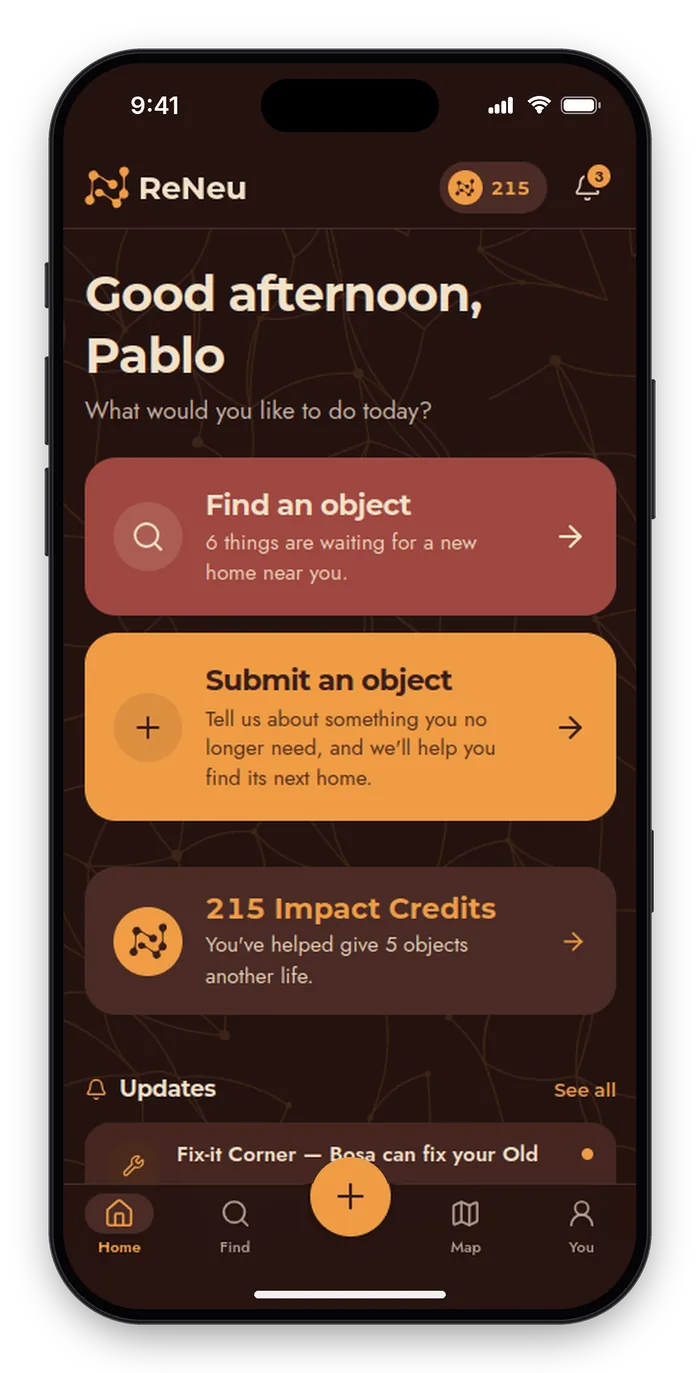
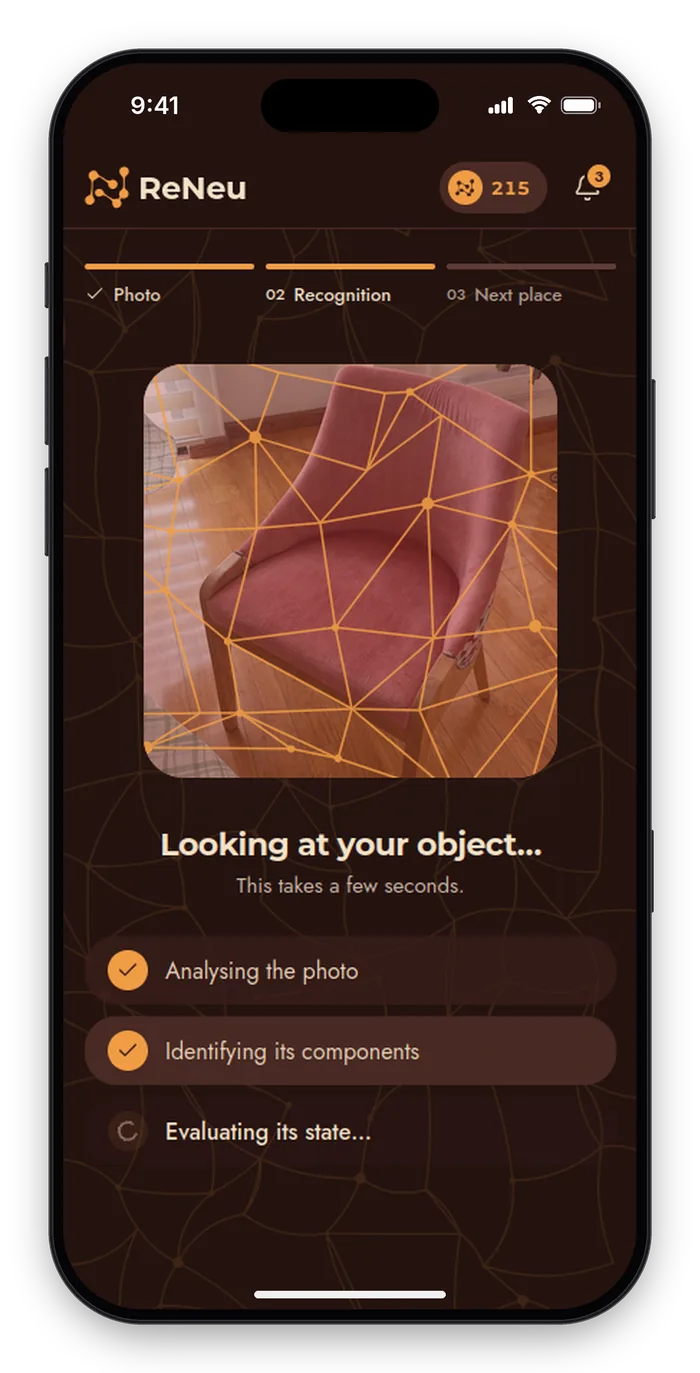
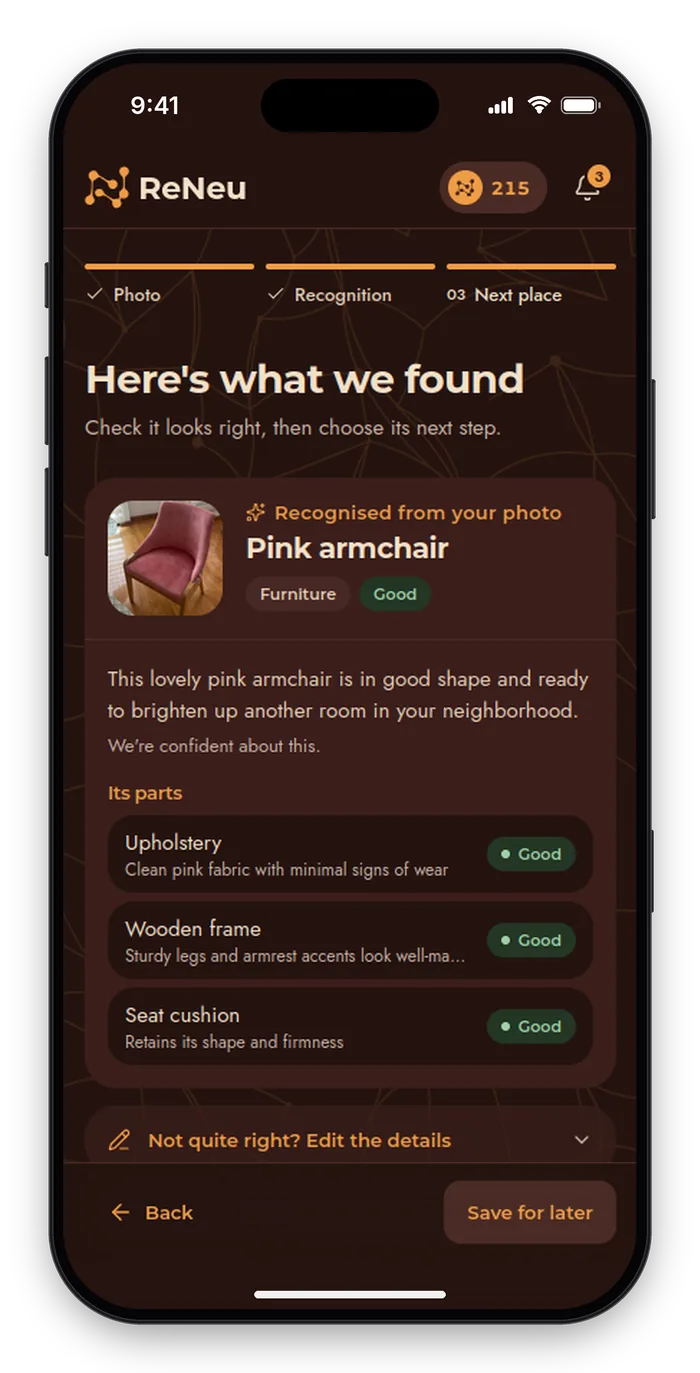
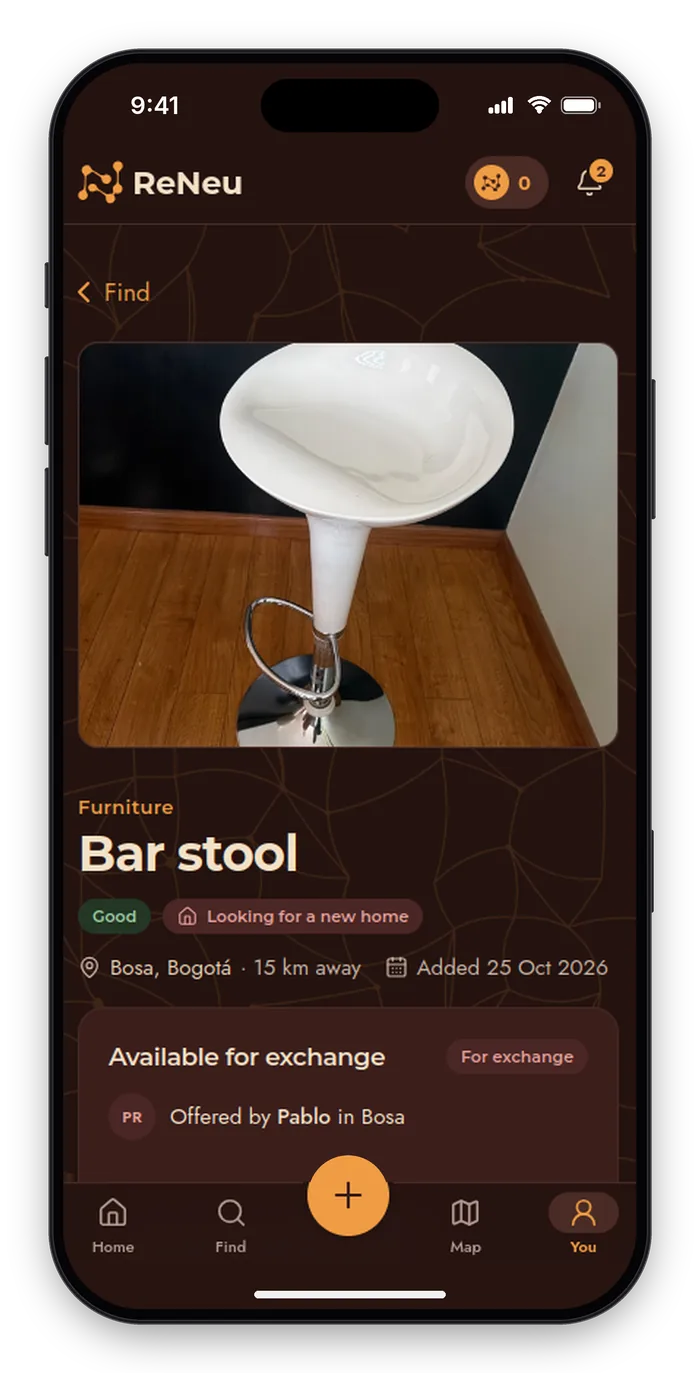
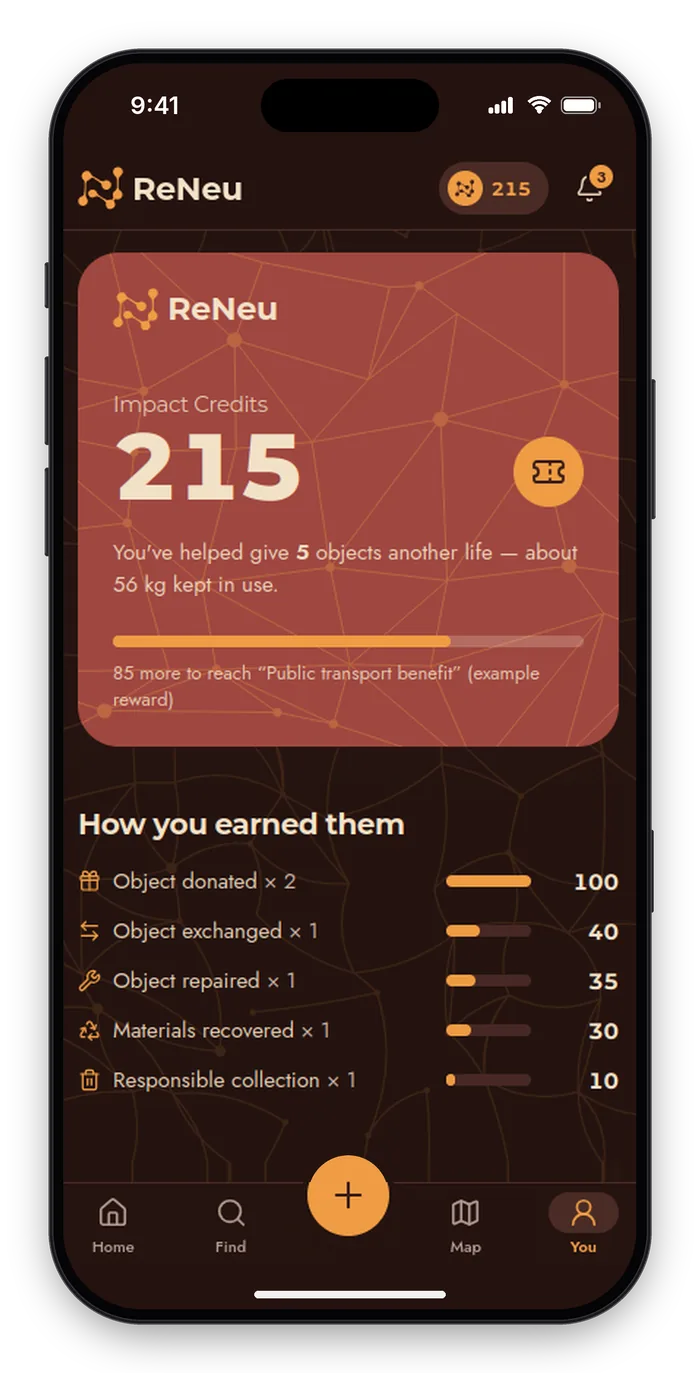
App screens designed by YA-CO-1. Proposed interface, not a released product.
Mobile Node
Then, connect the stuff to the city.
An AI spatial-intelligence layer decides where the network should reach, and turns that into routes that move with the city's rhythm.
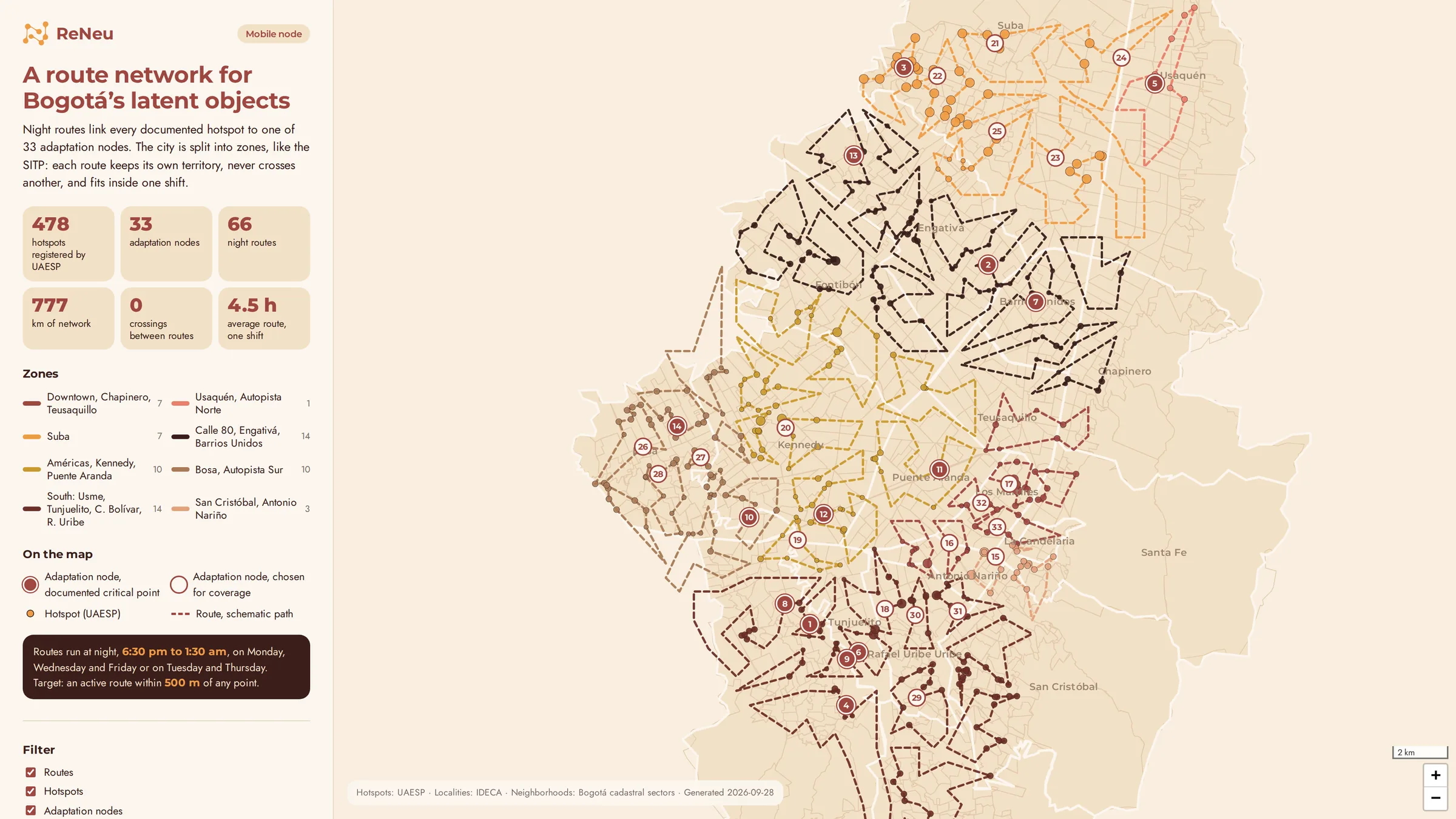
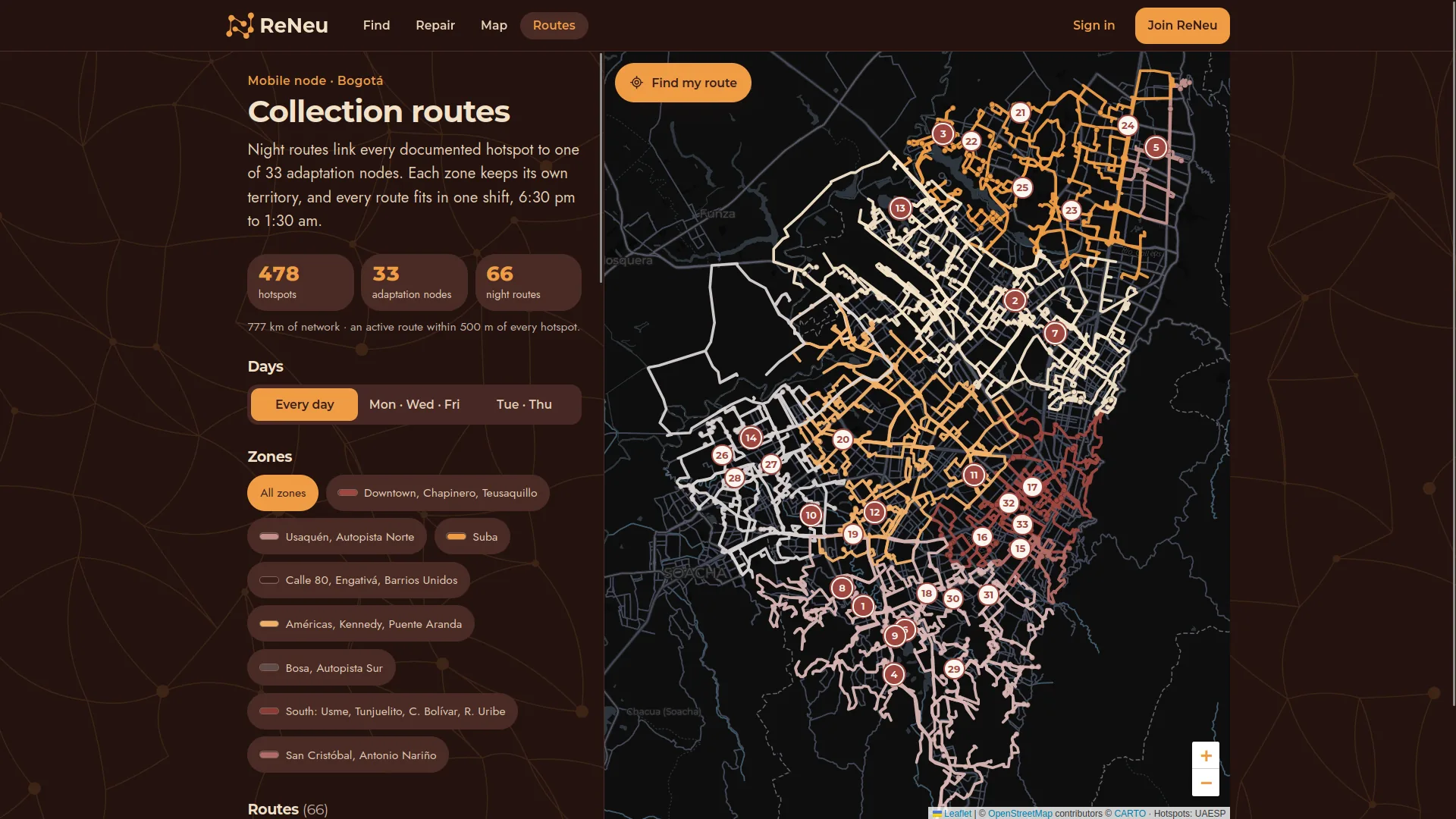
Interfaces of the Mobile Node designed by YA-CO-1. The view switches on its own; tap a tab to choose.
It reads demand points and how they relate to one another, finds clusters and gaps, and generates routes that can change with location, time and frequency. Network generation (where connections should exist) is kept separate from street-level execution.
What it reads
From points to routes
Eight moves, from scattered dots to named routes.
Hotspots, critical points and pickup requests are placed on the map.
Illustrative simulation of the process described by the team, not real city data.
How one request changes the map
A sofa can redraw a route.
A citizen interaction becomes network intelligence.
- Digital NodeA citizen registers a sofa
- RequestIt becomes a pickup request
- Mobile NodeIt lands on the map as a data point
- NetworkRoute, frequency and priority adjust
The 500-metre principle
From any point in the city, an active route within 500 metres.
Accessibility becomes part of what routes optimise for, next to distance, time and effort. Places outside the reach are flagged as inferred risk nodes: predicted gaps, not confirmed hotspots.
Routes people can recognise
Routes keep stable, locality-based names while the AI changes where, when, how often and with what priority they run.
Simulated neighbourhood, about 4 km across. Move your cursor or finger over the map.
Physical Node
Finally, give the network a place to act.
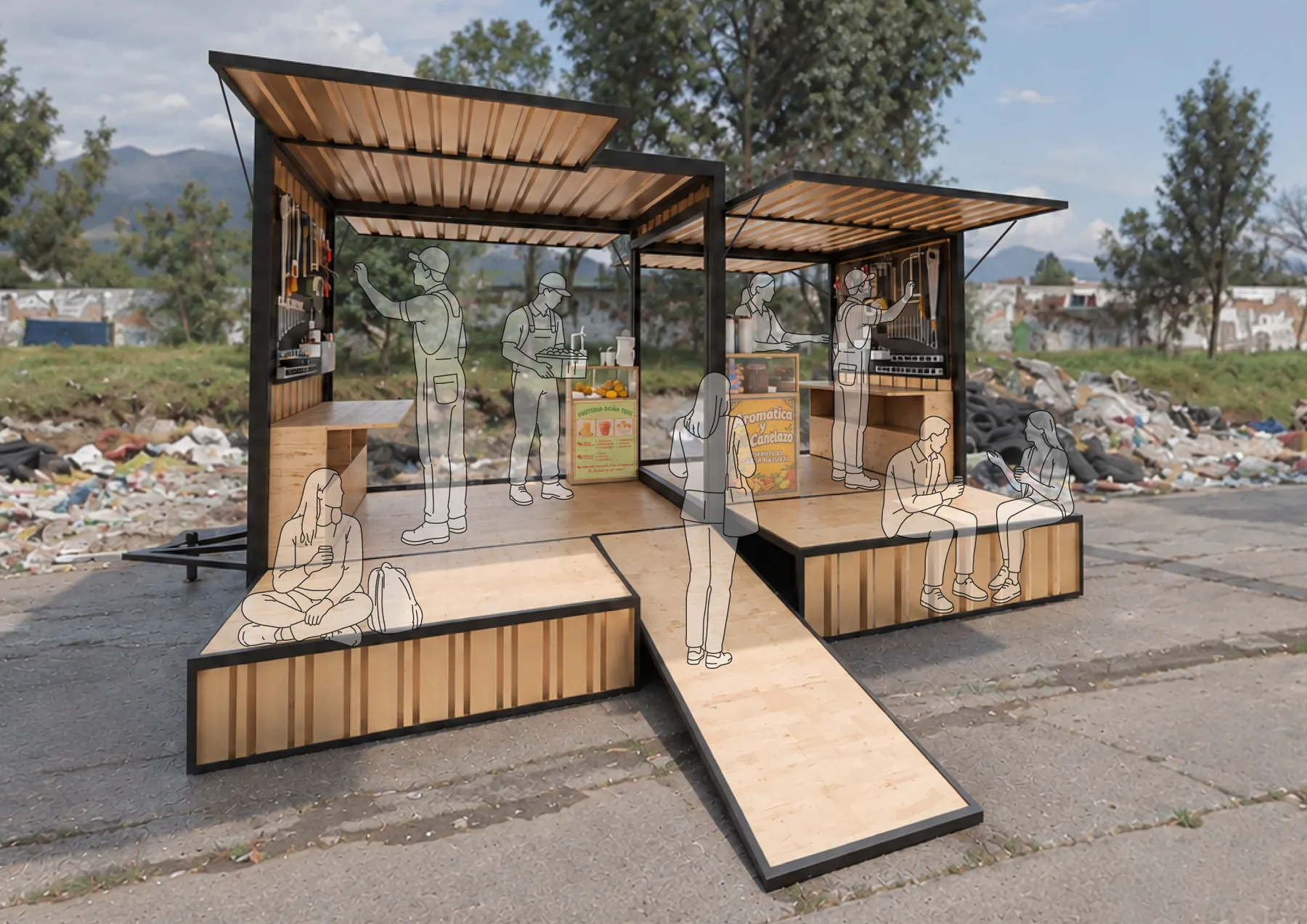
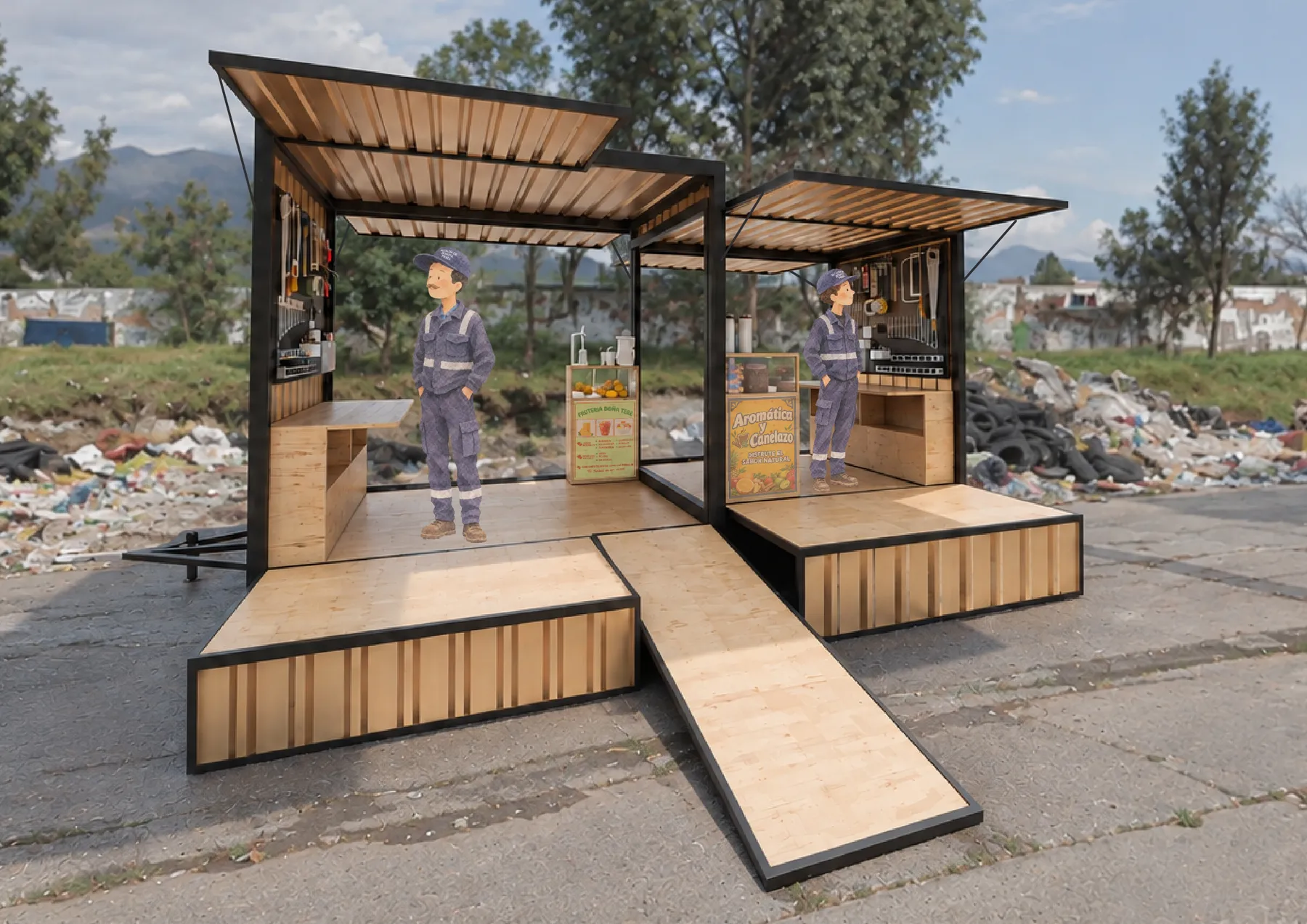
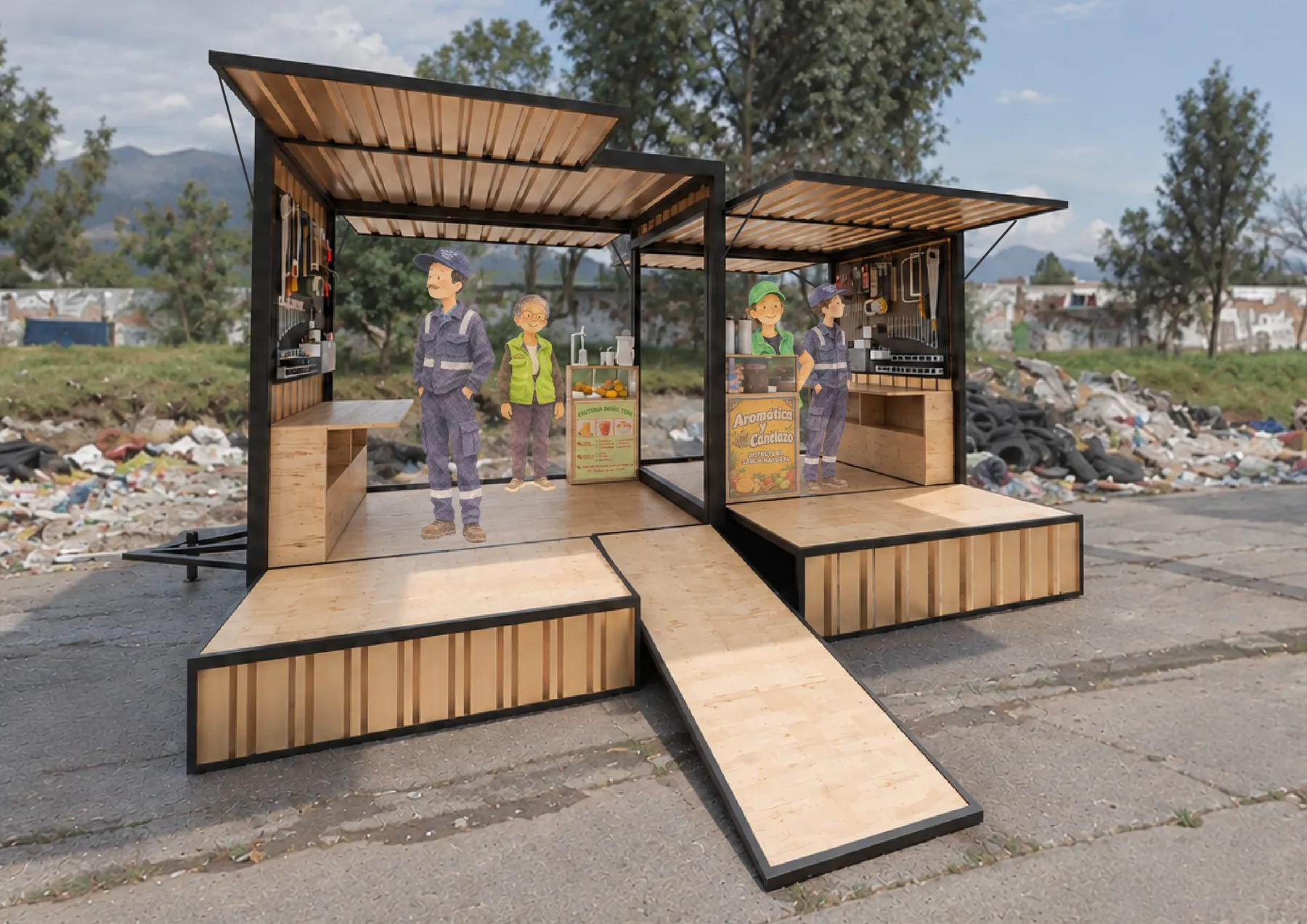
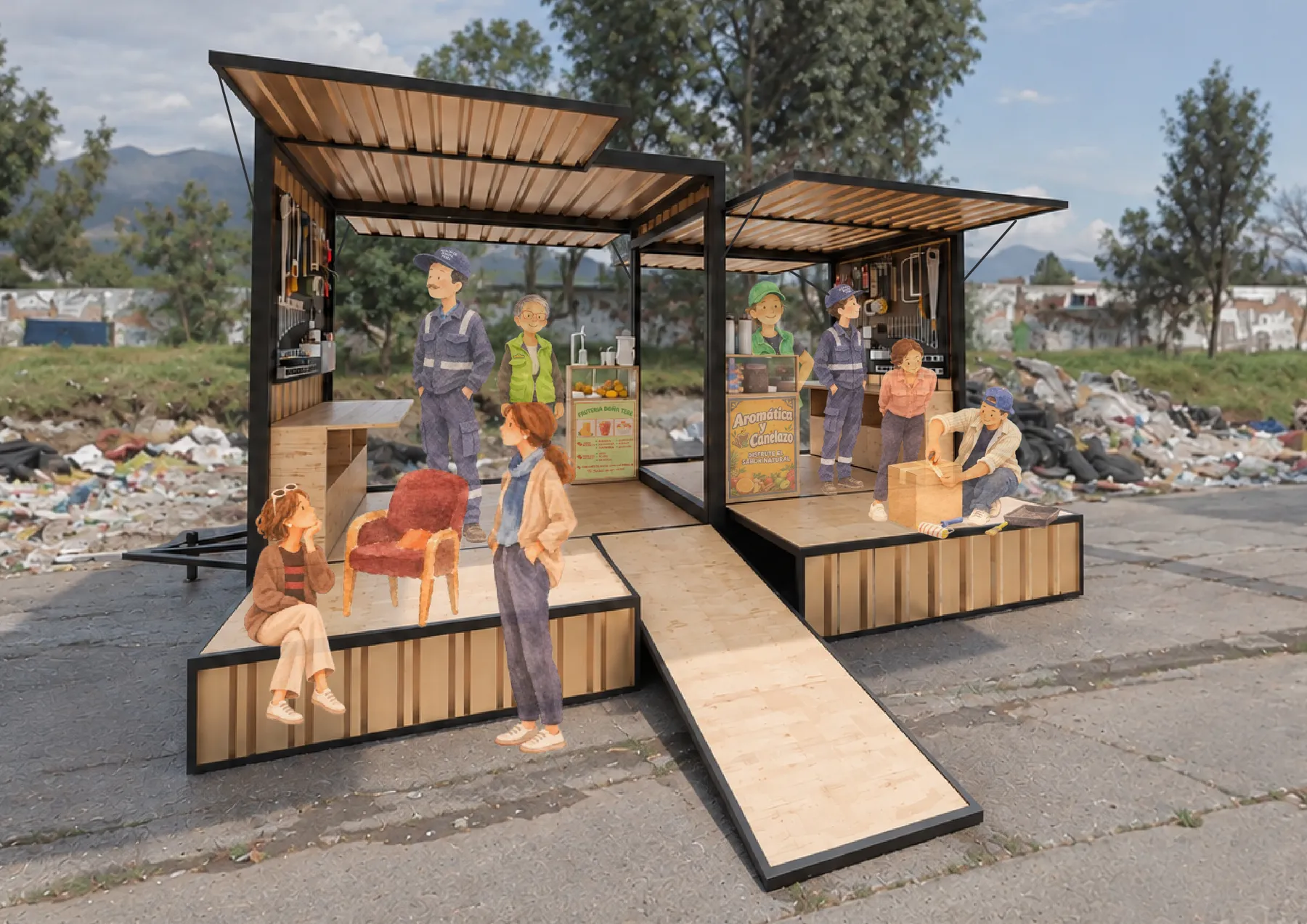
Renders by YA-CO-1. The site stops being a dumping point and becomes a node in the network.
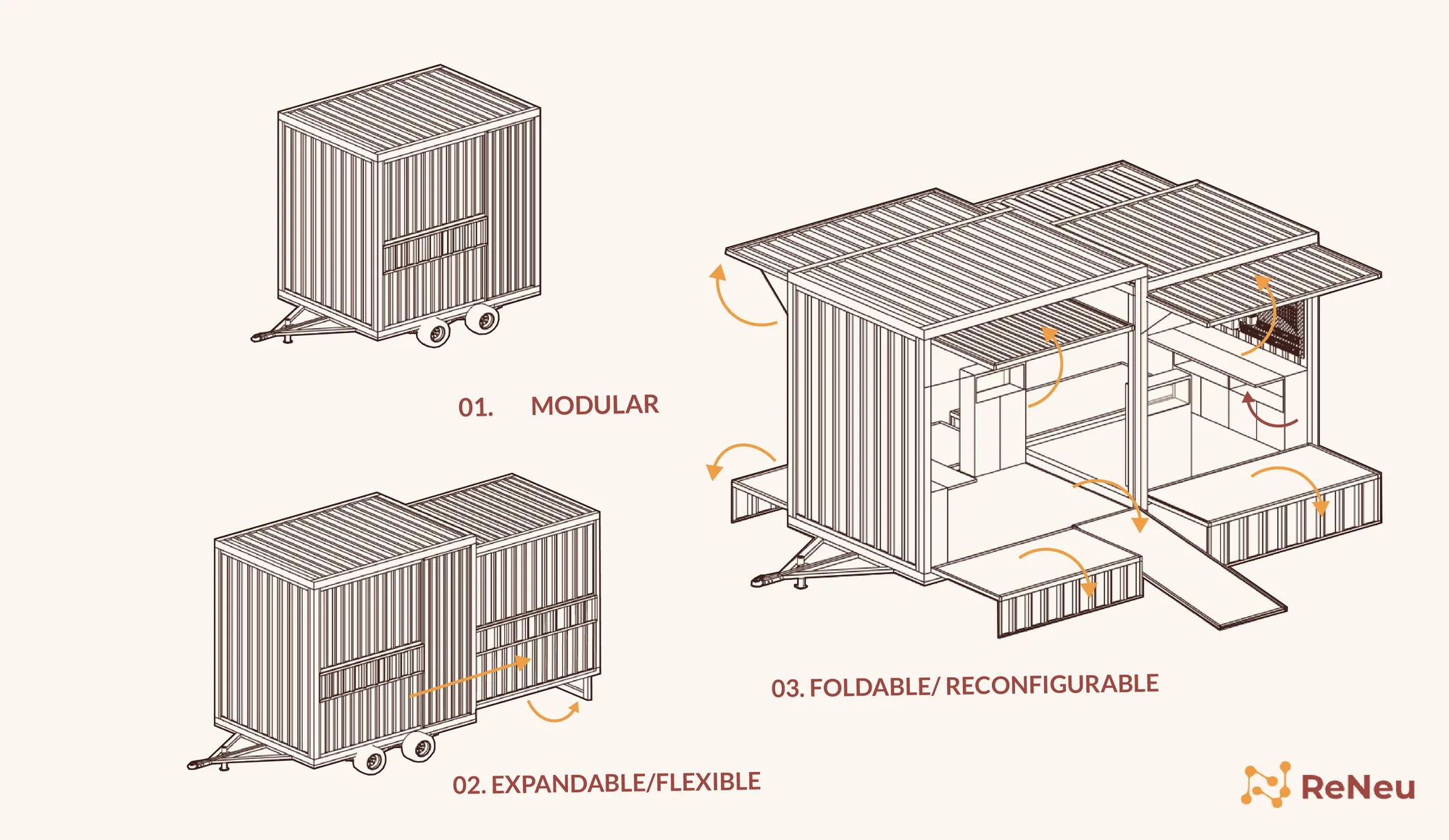
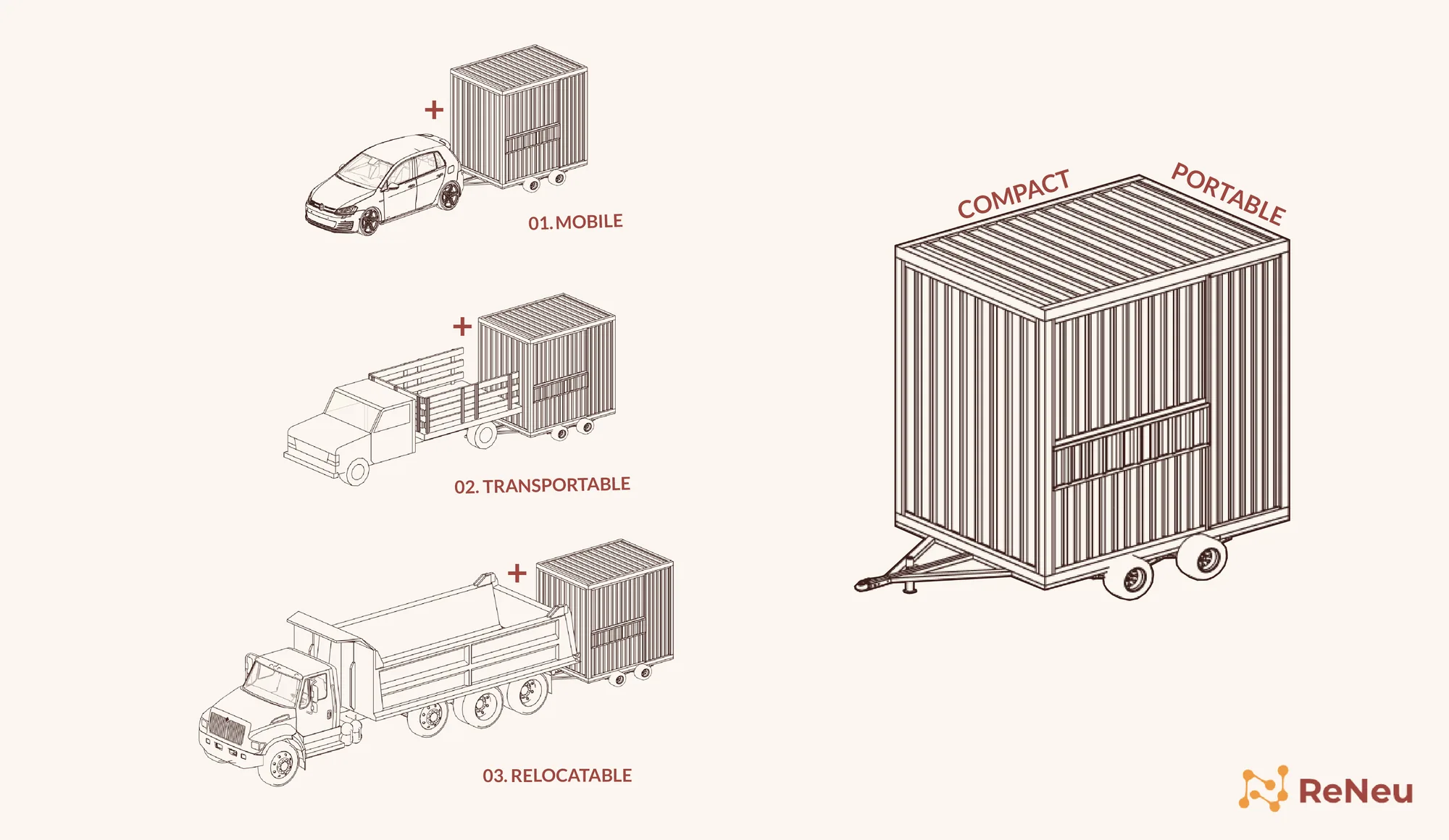
Deployable, adaptive urban infrastructure that brings together human expertise, AI-assisted tools and material-recovery capacity.
It does not simply receive waste. It activates potential.
Repair, exchange, transformation, disassembly, classification and material recovery happen in one place, alongside community participation and local economic activity.
Where should infrastructure go to meet citizens?
The workshop is flexible enough to be deployed when participation is highest, such as weekends.
Human expertise, supported by AI
Experienced workers stay at the centre. AI supports them with:
- Diagnosis
- Material identification
- Repair recommendations
- Tool selection
- Transformation options
- Recovery instructions
The team also mentions collaborative robotic assistance as a possibility.
What happens on arrival
A dumping point becomes a node in the network.
Value model
Value that comes back to the city.
Follow one sofa around the loop. What it is worth pays for the network, and the network pays citizens back for taking part.
A citizen brings a sofa to the network
Learning loop
Every action teaches the network.
Each registration, diagnosis, pickup request, hotspot, route, repair, material recovery and community intervention produces data. That data refines how objects, people, places and processes are connected.
The more it is used, the better it gets at connecting.
The meaning of latent stuff
Disposal may still happen. Just not first.
Some stuff will still need to be thrown away. ReNeu only asks that this happen after every other possibility has been explored.
The system sees
Waste
One path. The sofa leaves, and its value leaves with it.
ReNeu sees
Latent stuff
Expected impact
What a synaptic city could change.
The Digital Node offers possibility, the Mobile Node spatial connection, the Physical Node a place where it becomes real. Every new connection creates more possibility.
Intended outcomes · proposal stage, not yet measuredLess sent to Doña Juana
Materials re-enter productive cycles instead of going to Bogotá's landfill.
Fewer dumping hotspots
Accessible alternatives make the 478 illegal dumping hotspots less attractive.
Objects live longer
A longer useful life for furniture, appliances and construction materials.
Repair costs less than dumping
Reuse becomes cheaper and easier than disposal, reversing the logic behind illegal dumping.
Materials recovered
Wood, metal, plastics, glass and electronics return to supply chains and generate revenue.
A culture of adaptation
From disposal-first to adaptation-first thinking.
ReNeu
Every object has a next destination.
ReNeu is not a network designed only to move waste. It is a network for latent stuff. Waste is not always an object without value; sometimes its potential has simply been disconnected. ReNeu reconnects it.

Team YA-CO-1 · Next Generation Digital Action 2026, Challenge 6 · Academic partners: DTU Skylab, DTU Sustain and DTU Compute.